Showing posts with label ethics. Show all posts

Monday, March 7, 2011

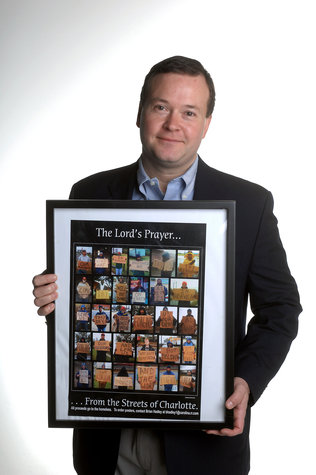
Charlotte Man's Poster of the Homeless Inspires and Multiplies // The Lord's Prayer and Beyond

Full article here // Excerpt below

By Elizabeth Leland

A Charlotte businessman created a poster of homeless people holding up words to The Lord's Prayer, which inspired a Winston-Salem surgeon to create a similar poster with words to a Bible verse, which in turn inspired a former teacher from Thomasville to create a poster.

Sales of the three posters have brought more than $14,000 to help the homeless.

And there's no telling where Brian Hadley's idea may turn up next.

Keep reading...

__________


I like this idea on a basic level--visually reclaiming the Lord's Prayer on behalf of ALL God's people, and I particularly like the approach to embodying Matthew 25 with one of the other posters. And from where I'm sitting right now in my old bedroom in my parents' house in Charlotte, I can turn my head just over my right shoulder and see one of those Lord's Prayer posters on my wall. I like the poster, and I was glad to see the article in this morning's Charlotte Observer.

But I'm currently taking Amy Laura Hall's introductory Ethics course at Duke Divinity, and we recently discussed representation via media of other cultures and socioeconomic stations--a distressing conversation about how to deal with issues like poverty and development without objectifying or exploiting the human beings on whom such "issues" ultimately center. So I'm hyper-aware of problems of paternalism and the like right now, and I can't help but get mildly uncomfortable at a photo of a businessman in a suit holding a framed poster covered with images of unnamed "homeless people."

There's nothing inherently wrong going on here, and I applaud Mr. Hadley's attempt to bring the Lord's Prayer "home" in a real, jarring way, particularly with a philanthropic thrust. I just wanted to name a few things that might have made me like the article (and maybe the poster too) even more: names. Stories. Reactions. It is inspiring--to middle class folks like me--to hear how this idea has spread and raised money for organizations supporting the homeless. But I'm curious how "the homeless" feel about it. How do they understand the Lord's Prayer? Matthew 25? In simply putting together the image, we're given a hint of a reflection on such questions, but no real answer. I want to challenge people like me to be concerned with such answers.

-- Sarah

Thursday, August 12, 2010

Should Mosque, Islamic Center Be Built Near Ground Zero? // Peace Offering or Something Else?

Source (From PBS NewsHour)

Interview With Toni Tortorilla, Female Catholic Priest // Roman Catholic Womenpriests Movement

Full article here // Excerpt below

From The Huffington Post

It's been three years since Toni Tortorilla was ordained in the Roman Catholic Womenpriests movement, and the Vatican's recent decision to label both pedophilia and women's ordination as grave offenses, she says, is an insult to clerical abuse victims and women seeking ordination.

"The sexual abuse of children is morally reprehensible by any possible standard," says Tortorilla, 63. "The ordination of women has been happening for decades in many denominations."

Keep reading...

Tuesday, August 10, 2010

Is Violent Rihanna-Eminem Song a Teaching Tool? // "Love the Way You Lie"

Full article here // Excerpt below

By Jocelyn Noveck

It's hard to forget the haunting photo that leaked out early last year: Pop star Rihanna, her elegant face bruised and battered after a violent assault by her then-boyfriend, R&B singer Chris Brown.

Now, she's appearing in something else shocking, though thankfully fictional: Rapper Eminem's chart-topping "Love the Way You Lie," a song (and now video [view below]) that graphically depicts a physically abusive relationship.

Keep reading...


Thursday, July 29, 2010

What Does WikiLeaks Reveal About Our Inner Selves? // From Speaking of Faith Observed

Full article here // Excerpt below

By Nancy Rosenbaum

Micah Sifry’s commentary on the unfolding WikiLeaks story on the war in Afghanistan has gotten me thinking about questions of trust and relationship-building in and beyond the realm of journalism and politics. At its worst, needing to keep our “seat on the bus,” as Sifry puts it, can result in collusion and self-censoring. Information or, put differently, necessary truths, get squelched in favor of preserving expedient relationships.

Keep reading...

Thursday, July 22, 2010

Solomon's Temple in Brazil would put Christ the Redeemer in the shade // Huge Replica Planned for Sâo Paulo

Full article here // Excerpt below

By Tom Phillips

One of the world's largest and most controversial Pentecostal churches has been given permission to build a $200m (£130m) replica of Solomon's Temple in Brazil's economic capital, São Paulo.

The 10,000 capacity "mega-church", which is the brainchild of Brazil's Universal Church of the Kingdom of God, will also house a replica of the Ark of the Covenant and be built according to "biblical orientations".

Keep reading...

__________


Here's a question many churches today need to answer: where is the line between being good steward of worship spaces/honoring God and falling into ostentation? -- Sarah

Wednesday, June 30, 2010

Why Christians Are Jerks Online // From CNN's Belief Blog

Full article here // Excerpt below

By Jonathan Acuff

"Bono is a born again Christian.

Or he's not.

It's one of those two. I'm just not sure which, but I am certain that the faith of U2 is something we Christians like to argue about. That and beer. You never know if your small group is populated with prohibitionists. You have to say things like, 'Is there anything you need me to bring to the dinner party, anything at all?' Then if they say, 'Sure, how about a bottle of wine?' you're good.

U2, beer, our favorite pastor's kid-gone-wild Katy Perry: these are usually the topics I write about on www.stuffchristianslike.net. (Which is indeed a direct rip off of the site www.stuffwhitepeoplelike.com.) But today I thought I might deal with something with a little sharper teeth. Something you don't see addressed often, but you might have experienced.

Put simply, I want to talk about why sometimes we Christians are jerks online."

Keep reading...

Monday, May 24, 2010

Must Art Be Ethical? // Flash Points Wrap-Up: Art for Life

By Catherine Wagley

A friend of mine dated a composer once. He was a good composer. People found his music “inventive” and “ubiquitous” (in a good way). All of his friends were musicians, artists, or filmmakers and they seemed to be good at what they did too—they cared about craft and they promoted themselves and each other well enough to ensure that a like-minded posse would always be around when they debuted new work. At first, this scenario seemed perfect: having a composer boyfriend with creative friends who made things all the time. But my friend soon noticed that none of these people showed much interest in the meaning of what they were making. She would go to openings at which the art on exhibit looked unambitious, sometimes exploitative or hackneyed, but criticism, even veiled skepticism, was unthinkable. This was a loyal tribe. If you were in, you were in, no matter how brilliant or lifeless your work might be.

Only once did a member of the tribe—an indie rocker from a band-you’ve-definitely-heard-of—get axed. He slept with a girl he shouldn’t have slept with, and, after that, his cohorts weren’t his cohorts anymore. My friend understood why the rocker’s behavior would be reprehensible, but she wondered why his music, a heavy-handed brand of emo that turned human experience into a spurt of blind antagonisms, hadn’t played even a small part in his excommunication. How could a group of artists so effortlessly separate the code they lived by from the art they made?

“You’re not really supposed to discuss moral and ethical matters around contemporary art,” wrote Ben Street, a month into the Must Art Be Ethical? debate. “Express discomfort at Sierra’s synagogue or Fraser’s fornication . . . and your contemporary art membership card is permanently revoked.” This, Street suggested, is a measure of contemporary art’s insecurity with itself. Such insecurity could come from numerous sources, many of which played out during the ethics discussion we’ve had on this site these past few months: modernism, money, representation (also here), quantity, institutional policies, power, education, art world politicshere), artistic process, and the definition of what artists even are.


“Artists are an educated class of cultural producers who routinely challenge ‘moral authority’ and share a tolerance for minority perspectives,” wrote artist William Powhida in his March 18 post. But, as Jennifer Dalton, who co-curated the recent #class exhibition with Powhida, pointed out, “The art world is not such a tolerant place.” She continued, “We don’t like conservatives, even socially-liberal-fiscally-conservative ones . . . . Our commitment to free expression is limited to the types of ‘transgressions’ we are all entirely comfortable with.”

Laura Fried’s recent post discussed one transgression with which we’ve become comfortable: institutional critique. “The great weakness of institutional critique,” she said, “was its failure to move beyond the exposure of unethical (or questionable) institutional practices in favor of affecting real change.” Fried points to Carey Young as an example of an artist who activates her audiences with change in mind. Of course, believing that art can affect real change requires admitting that something should change, and admitting that something should change requires taking an ethical stand on both life and art.

It’s hard to talk about art as ethical or unethical. It’s often easier to critique the ethics of the art world. Wrote Ben Street:

The conflation of object and its receptive context make ethical discussions about art really ethical discussions about how the art world behaves. This is like blaming money itself for the financial crisis. . . . I want to address the question in the way I first interpreted it: can there be anything ethical about art itself, or is it perpetually at one remove from the conversation? Can art itself be, now, a proposal about how to live?

Poet Ariana Reines once said she writes because she’s interested in living her life. Poetry acted metonymically, like a living stand-in. Good art, Ed Winkleman pointed out, is neither ethical nor unethical. It’s just good. But if we really take it seriously, it affects the way way we understand life and, if it affects the way understand life, then it affects the way we understand ethics and it affects the way we live.