Showing posts with label poverty and homelessness. Show all posts

Thursday, April 7, 2011

At this Shelter, Art Studio Helps the Homeless Paint a Brighter Future // Metro Atlanta Task Force for the Homeless

Full article here // Excerpt below

By Lori Chapman

An art studio doesn't usually make anyone's list of what the homeless need.

But when Anita Beaty decided to start painting in the storefront window of a homeless shelter, people were soon looking in and asking to join.

"It seemed to me that there were lots and lots of creative people among folks who were experiencing homelessness," Beaty says.

And she would be familiar with their needs -- Beaty is the executive director of the Metro Atlanta Task Force for the Homeless. She'd been looking for a way to combine her love of art with her passion for eliminating poverty.

Keep reading...


Monday, March 7, 2011

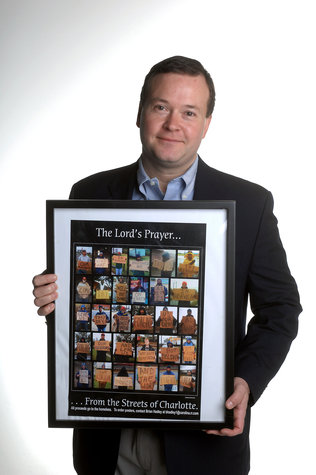
Charlotte Man's Poster of the Homeless Inspires and Multiplies // The Lord's Prayer and Beyond

Full article here // Excerpt below

By Elizabeth Leland

A Charlotte businessman created a poster of homeless people holding up words to The Lord's Prayer, which inspired a Winston-Salem surgeon to create a similar poster with words to a Bible verse, which in turn inspired a former teacher from Thomasville to create a poster.

Sales of the three posters have brought more than $14,000 to help the homeless.

And there's no telling where Brian Hadley's idea may turn up next.

Keep reading...

__________


I like this idea on a basic level--visually reclaiming the Lord's Prayer on behalf of ALL God's people, and I particularly like the approach to embodying Matthew 25 with one of the other posters. And from where I'm sitting right now in my old bedroom in my parents' house in Charlotte, I can turn my head just over my right shoulder and see one of those Lord's Prayer posters on my wall. I like the poster, and I was glad to see the article in this morning's Charlotte Observer.

But I'm currently taking Amy Laura Hall's introductory Ethics course at Duke Divinity, and we recently discussed representation via media of other cultures and socioeconomic stations--a distressing conversation about how to deal with issues like poverty and development without objectifying or exploiting the human beings on whom such "issues" ultimately center. So I'm hyper-aware of problems of paternalism and the like right now, and I can't help but get mildly uncomfortable at a photo of a businessman in a suit holding a framed poster covered with images of unnamed "homeless people."

There's nothing inherently wrong going on here, and I applaud Mr. Hadley's attempt to bring the Lord's Prayer "home" in a real, jarring way, particularly with a philanthropic thrust. I just wanted to name a few things that might have made me like the article (and maybe the poster too) even more: names. Stories. Reactions. It is inspiring--to middle class folks like me--to hear how this idea has spread and raised money for organizations supporting the homeless. But I'm curious how "the homeless" feel about it. How do they understand the Lord's Prayer? Matthew 25? In simply putting together the image, we're given a hint of a reflection on such questions, but no real answer. I want to challenge people like me to be concerned with such answers.

-- Sarah

Friday, January 14, 2011

The Healing Power of Music and Haiti Noir // The Arts in Haiti, One Year After the Earthquake

Click here to listen American Public Media's The Story's recent program on the healing power of the arts in Haiti one year after the devastating earthquake:

The healing power of music

Jean Montes grew up in Haiti. He attended the Holy Trinity School of Music before coming to the States to become a conductor and musician. When the earthquake struck one year ago this week, his thoughts were of his beloved school and students. Jean knew his country needed food, water and shelter - but they also needed hope. Since then he has taken hundreds of instruments to Holy Trinity to give to young students through the Haitian Youth Music Relief.

Haiti Noir

Patrick Sylvain is a Haitian - American writer. He had planned to fly into Haiti on the day of the earthquake - but he did not. When the quake happened, Patrick was safe in the US. Later, he went to Haiti to help the people. He's made some sense of his own emotion through his contribution to the new book Haiti Noir.

Wednesday, October 20, 2010

2011 TED Prize awarded to Artist who gives slums a Human face

Full Article Here // Excerpt Below

by Randy Kennedy

It’s not common for important philanthropic prizes to go to people whose work involves criminal trespass and who make statements like the following: “You never know who’s part of the police and who’s not.”

But the TED conference, the California lecture series named for its roots in technology, entertainment and design, said on Tuesday that it planned to give its annual $100,000 prize for 2011 — awarded in the past to figures like Bill Clinton, Bono and the biologist E. O. Wilson — to the Parisian street artist known as J R, a shadowy figure who has made a name for himself by plastering colossal photographs in downtrodden neighborhoods around the world. The images usually extol local residents, to whom he has become a Robin Hood-like hero.

Monday, August 30, 2010

Remembering Hurricane Katrina 5 Years Later

OK, I'm biased--part of this news piece was shot in my living room and features my parents and pictures taken by my sister. :) -- Sarah

__________


Saturday, August 28, 2010

Looking for the "Black Mamba Boy" // Debut Novel by Nadifa Mohamed chronicles a Somali orphan's odyssey


Article in Full Here // Excerpt Below

by Lorraine Adams

Nadifa Mohamed’s ambitious first novel tells the story of a Somali orphan’s odyssey from Yemen to Djibouti, onward to Eritrea, Sudan, Egypt, Palestine, Marseille, Hamburg and Wales — and ultimately to an epiphany in London. Toward the end of this trek, the hero meets up with an old friend, with whom he competes “over who had walked the farthest, starved the longest, felt the most hopeless; they were athletes in the hard-luck Olympics.”

Wednesday, August 25, 2010

Putting New Tools in Students' Hands // Experimental Design Classes at Poor, Rural NC Schools

Full article here // Excerpt below

By Alice Rawsthorn

Why would you study design if you weren’t planning to become a designer? Especially if you were a high school student in a depressed rural area of the United States, like Bertie County, one of the poorest counties in North Carolina, where 80 percent of students live in poverty, and your best chance of employment will be a low-skilled job in agriculture or biotechnology.

Keep reading...

Tuesday, July 20, 2010

What Amazes a Group of Disaster Doctors? // "Jesus, Thank You for Loving Us" Resounds in Port-au-Prince

Full audio here // Description below

"As this NPR radio report has revealed, Haiti’s poor have demonstrated an amazing faith in Christ during the worst of this ordeal." Click the link above to hear this moving program that tells the story of hymn bursting out spontaneously in a hospital in a devastated part of Haiti.

Wednesday, June 30, 2010

Local Musician Speaks Out for Compassion // Visiting a Sponsored Child in El Salvador

Local musician Gary Mitchell uses the tagline "Music with a Message." Whether he is playing in a coffeeshop or bar, performing at the Ronald McDonald House or leading worship at Orange United Methodist Church in Chapel Hill, Gary is dedicated to using good music to bring smiles to people's faces and to spread a simple message: "You are not alone. God made you, God loves you, and Jesus Christ can change your life if you trust him."

Drawing on a background of drums, percussion, guitar, piano and classical voice, Gary is always looking for new ways to use his talents to help others and to further God's kingdom. So it is no surprise that after sponsoring two children for several years through Compassion International, Gary recently joined Compassion's Artist and Speaker Network. Compassion provides associated performers with materials for promoting the organization and encouraging awareness of poverty in the world; the first person Gary was able to bring into the fold as a sponsor came forward at a show at Hope Cafe--check out this blog post about the spot.

Gary's recent experience of traveling to El Salvador to meet Karen (on a group tour sponsored by Compassion) gave him even more motivation to support the organization. Here's a snippet from his blog reflecting on the trip:

"Compassion International is a real life miracle that is changing lives and communities all over the world, attacking poverty with the redemptive love of God. If you’ve ever been slapped in the face with the true depth of affluence and privilege you have, been compelled to do something to help others and then come up short to find a way to make a real difference, I encourage you---I beg you with all that I can; find a way to free up 38 dollars a month and join me in helping this outstanding organization battle child poverty."

To get a taste of Gary's experience meeting Karen, check out the video below, or click here to read his complete blog about Compassion and the trip to El Salvador.


Friday, June 11, 2010

Rural Studio and an Architecture of Decency // Speaking of Faith

"Auburn's Rural Studio in western Alabama draws architectural students into the design and construction of homes and public spaces in some of the poorest counties. They're creating beautiful and economical structures that are not only unique but nurture sustainability of the natural world as of human dignity."

Read, see and hear more here.

Saturday, May 8, 2010

Water with a Conscience at Annenburg Space for Photography // "Water: Our Thirsty World"

As the world faces the challenge of the Deepwater Horizon oil spill, we have renewed cause to contemplate the role of water in our lives. A good place to start is at the Annenberg Space for Photography’s current exhibit, “Water: Our Thirsty World.”

The exhibit is in partnership with National Geographic Magazine and features photos from a special issue of the magazine. It’s split into six themes, each of which explores the role of water in human life and its relationship to our survival and that of the planet. The documentary-style images are bright, bold and arresting and serve as vivid guideposts to the complicated social and ecological issues surrounding water resources and arid lands.

The Annenberg space is the photographic equivalent of theater in the round, with pictures arranged in an aperture-like circle around a multimedia presentation space. The “Water” exhibit begins its journey on one side of the sphere. with photos from a series called “The Big Melt,” which examines what’s called “the great melt of the Tibetan Plateau,” an endangered glacial source that reportedly supplies nearly 40% of the world’s water.

In a caption, 16-year-old Vinay says, “‘If you throw money here, no one would have time to grab it. Water is more important to us.’ “

Despite many images of bright-blue liquid, the exhibit is more about the desperation generated by thirst.

Some of the exhibit’s most breathtaking images come from the series “The Burden of Thirst,” in which photographer Lynn Johnson follows the daily journey of Kenyan women as they walk through miles of stark desert -- colorful skirts and headdresses flapping around their thin, dark legs -- with bright yellow containers of water on their backs. A drought in that country has made retrieving safe drinking water even more difficult, and as the caption points out, “If the millions of women who haul water long distances had a faucet by their door, whole societies could be transformed.”

More familiar is “California’s Pipe Dream," in which pictures by Edward Burtynsky show vast expanses of suburban land with cookie-cutter tract homes that have been abandoned, their once-verdant lawns returning to a natural, arid state. Other images show Los Angeles freeways and sprawl, a desert region fed by imported water.

The exhibit comes full circle with touching pictures from the series “Sacred Waters,” which documents humanity’s communal, religious and ritualistic use of water. A giant print by John Stanmeyer depicting half-naked men and women rolling, bathing and dancing in the crisp, cold water of the Saut d'Eau waterfall in Ville Bonheur, Haiti, during the Festival of the Virgin of Miracles seems to embody the almighty, life-giving power of water.

"Water: Our Thirsty World": The Annenberg Space for Photography, 2000 Avenue of the Stars, No. 10, Los Angeles. Wednesdays to Sundays, 11 a.m. to 6 p.m., through June 13. Free. (213) 403-3000, www.annenbergspaceforphotography.org.

-- Jessica Gelt

Thursday, May 6, 2010

Sans Houses // Nashville's Homeless Community Captured through Photography, Sound and Relationship

This blog "utilizes photography, sound, and relationship to attempt to capture a piece of those in and around the homeless community in Nashville." The most recent posts show the effect of the flooding on residents of Tent City and other homeless communities in the area. The photos are incredible and put a human face with Nashville's homelessness problem.

Many of the men and women pictured are writers and vendors for The Contributor, Nashville's street newspaper: "We
strive to print a monthly paper that provides both a diversity of perspectives on homelessness and a source of income for homeless and formerly homeless individuals while creating community between vendors and customers."

Film: No Woman, No Cry // Every Mother Counts

In her gripping directorial debut, Christy Turlington Burns shares the powerful stories of at-risk pregnant women in four parts of the world, including a remote Maasai tribe in Tanzania, a slum of Bangladesh, a post-abortion care ward in Guatemala, and a prenatal clinic in the United States.

Learn more about the film here, and join the effort to improve maternal health and reduce maternal mortality at Every Mother Counts.


"Like many women, I was excited to become a mother and enjoyed being pregnant. But just after delivering my first child, I suffered a serious complication. While I had a birth team that worked quickly to manage the situation, I was shocked to learn that more than 500,000 women die each year during childbirth—and that 90 percent of these deaths are preventable. This left me needing to learn more about maternal health.

I have since become the Maternal Health Advocate for the Cooperative for Assistance and Relief Everywhere (CARE) and enrolled in the Masters of Public Health program at Columbia University's Mailman School. But I still felt helpless, frustrated by the reports that maternal mortality numbers were not dropping. I was inspired to make a documentary film that would share the stories of women at risk of becoming a mortality statistic. I hope that by bringing people together through the universal experience of birth, we can help create a mainstream maternal health movement that ensures the lives and well-being of mothers worldwide, for generations to come."


Tuesday, May 4, 2010

"Now that I have seen, I am responsible" // Brooke Fraser's Musical Call to Missions


Brooke Fraser, whose voice you might recognize if you listen to Hillsong United at all, has a fantastic solo album called Albertine. This is the title track, an almost chilling call to see and respond to need. "Now that I have seen / I am responsible / Faith without deeds is dead." The entire album is a musical exploration of Scriptural and theological themes, evinced by song names like "The C. S. Lewis Song" and "Hosea's Wife," but "Albertine" in particular is a great example of music engaging with missions, and the music video drives that point home.

Wednesday, April 28, 2010

@ UNC's School of Journalism through May 17 // "On the Edge": Homeless and Working Among Us

Between strength and instability, between vulnerability and pride are the working poor. One paycheck away from being homeless…again. Everyday they maintain the balancing act of holding a job and simply holding it together. Everyday we see them teaching and caring for our children, working in the stores and restaurants we frequent, and providing vital services to our community; we never know how close to the edge they really are.

Photographer and project creator Susan Sidebottom has captured working families on the uphill climb from homelessness to housing in “On the Edge: Homeless and Working Among Us.” Come to understand their experience through the power of the image.

__________


Click here to learn more about the exhibit or view the full collection at the University of North Carolina at Chapel Hill, School of Journalism and Mass Communication, Carroll Hall, through May 17, 2010.